













What objectives should be set for the coming year?
During the months of summer, it is possible that a large part of the staff, management and also the clientele may have been away on holiday. For this reason, September is usually an ideal month to set new sales objectives to be met and to establish a plan for doing so.
There may be many things you would like to improve or those points you should reinforce in your sales. So, how do you set objectives that your sales team is motivated to meet?
Firstly, a concept you may have heard is that goals must be SMART, that is, by its translation, you understand, and also by its acronym: specific, measurable, achievable, relevant and time-bound.
Meeting these requirements is vital, as objectives that are too abstract or very difficult for your team to take on will be counterproductive.

With this in mind, today we want to propose 5 goals to achieve in 2024, which you can set right now to motivate your team and increase productivity after the holidays.
In addition, for each objective we propose a key metric to take into account to measure whether these objectives are met and exactly what margin of success your efforts are having.
5 SMART goals for your sales
1. Increase Sales Closing
A common objective is to increase the number of closed sales. A good timeframe for this would be to take stock compared with last year at the halfway point, after six months, and another at the end of the year.
At this point there is an issue that tends to be of great interest to employees: bonuses for individual quotas. This is, without a doubt, a good way to motivate each of the salespeople. However, it is also important that you try to set collective objectives.
If you want to know more, here is our article on why the era of the «lone wolves» in sales is coming to an end and the advantages of opting for a collaborative sales network:
Change the focus: collaborative selling can transform your sales
On the other hand, it is interesting to set exact figures when establishing this type of objective. You could propose an increase in sales closing of between 10% and 20% or, preferably, adapt this objective according to the predictions that data analysis from other years allows you to make.
Key metric: Sales Closing Rate
It measures the number of closed sales in relation to the total number of opportunities. An increase in this metric indicates greater success in converting prospects into customers.
2. Optimise the Sales Cycle
It is common in some companies for management to get «stuck» on numerical objectives. However, a realistic objective that is worth proposing with the whole team is to change the sales cycle. By optimising the process with digital tools it is possible to reduce the time it takes to convert a prospect into a customer. This, of course, may depend on each salesperson, but it will also depend on the sales strategy designed by the board of directors and sales management.
Once it has been decided what investments to make to improve the sales cycle, more specific and numerical goals can be set, such as what % of the sales cycle should be shortened within a certain timeframe.
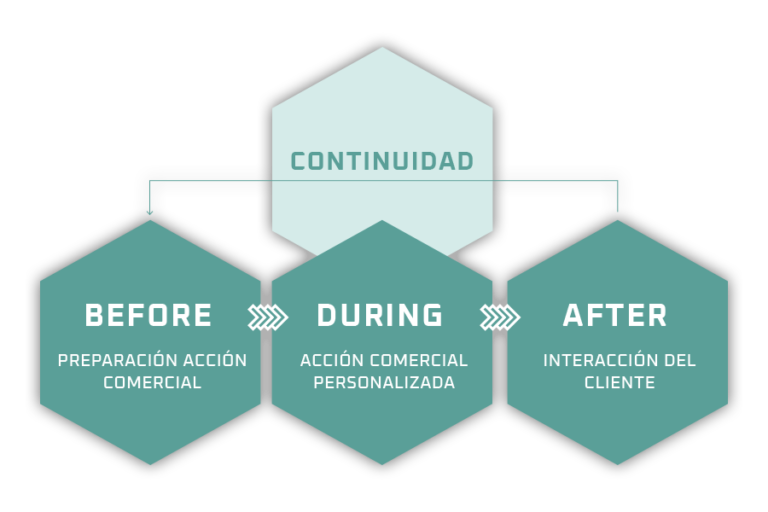
Besides, for this objective, it is key to opt for the digital adoption of the entire sales team, as they will be the ones who make this type of change effective and result in an improvement in sales.
Key metric: Average Sales Cycle
It calculates the time the sales cycle takes from the first contact to the closing of a sale. A shorter sales cycle suggests greater efficiency.
3. Improve prospect conversion
An objective that should be a priority for your sales strategy is the conversion of leads or prospects. It is common in a company for each salesperson's objective to be to maintain sales with regular customers or to increase the purchase rate among these regular customers.
However, a key indicator of sales success will always be prospect conversion, as it shows us whether or not there really is steady growth in the company.
Key metric: Conversion rate
It evaluates how many of your prospects become customers. An improvement here is key, as it would indicate a significant increase in your revenue.
4. Increase customer retention
The latter, of course, without abandoning the importance of retaining existing customers. That is why it is so important to optimise your sales team through Sales Enablement.
Businessman using tablet analyzing sales data and economic growth graph chart on virtual interface. Business strategy. Abstract icon. Digital marketing.You need your salespeople to find the time and the necessary tools to offer regular customers a good experience, and even improve it to increase the loyalty rate, while at the same time being able to capture leads and improve the conversion rate.
Key metric: Retention rate
A higher retention rate usually translates into recurring revenue. Your customer loyalty rate can indicate long-term growth, although it should be measured in parallel with the conversion rate and take into account whether it is possible to establish new deals with regular customers.
5. Improve salespeople's productivity
In relation to what we said earlier, without a sales team capable of carrying out these improvements, it makes no sense to set goals, as none of them will be entirely realistic.
So, a good investment to face the new year with more strength is to consult with an external company that offers Sales Enablement solutions to optimise your sales team.

Sales Enablement is defined as a process that allows you to maximise the company's profits through the improvement of salespeople. The idea is to ensure that salespeople use the most appropriate content and communication for each phase of the customer's purchasing process.
With the necessary resources, you can then set your salespeople the goal of increasing the amount of time they devote to effective ones. For example, the automation of repetitive routine tasks can reduce the time salespeople spend on more administrative or preparation functions, giving them more scope to devote their efforts to higher value-added actions.
Key metric: Time devoted to effective sales
Measure how much time your salespeople spend on effective sales activities. An increase in this metric indicates whether valuable time has been freed up to close more sales.
In conclusion, once you decide to implement a Sales Enablement strategy in your company, it is essential to continually evaluate your results.
Setting clear goals and measuring success is essential to improve the performance of your sales teams and achieve your strategic objectives. In this sense, the most valuable thing is to have useful metrics in your hands, which allow you to periodically evaluate the results
Remember, sales must be marked by continuous improvement. That way, you will be on the right path to maximise the impact of your Sales Enablement strategy.