









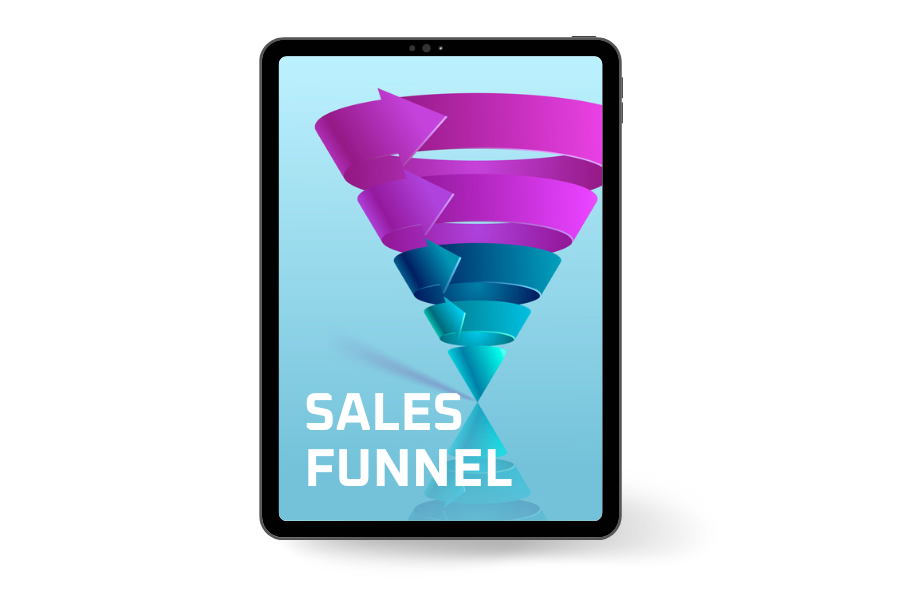
The concept of funnel or funnel sales, is one of those concepts that are frequently heard in the commercial sphere. So much so that it is easy to have an abstract idea of what it is, without stopping to analyse what it exactly is and how it can help us.
What is a sales funnel?
If we imagine a funnel, we immediately understand that it is a resource that helps us channel something, so that the maximum amount reaches the end of the journey.
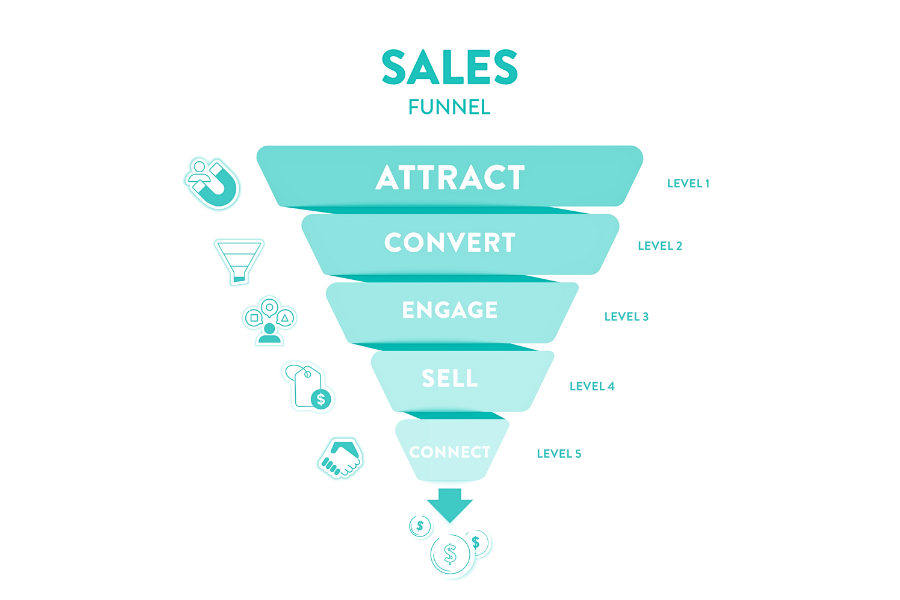
Well then, a sales funnel is a method by which a company plans and establishes the different phases to follow to meet a commercial objective. With the funnel, the processes are established from when contact with potential customers begins until the end of a process, which is usually the closing of the sale.
A sales funnel helps companies with a visual representation of their sales process and helps sales teams to better track their activity, since each «deal» with the customer indicates the passage from one phase to another.

In this way, a sales funnel is a key tool, since the segmentation of the sales process allows a better analysis of it, and not only at the end of the sale, but at each phase. Thus, with constant monitoring and the management of daily sales activities , we help the salesperson to be more efficient.
The 5 phases of the sales funnel
Apart from constant monitoring, good management of commercial actions requires precision, to ensure that in each negotiation with the customer we are taking the appropriate approach for that moment in the sales cycle.
Therefore, when establishing our sales funnel, the first thing is to define how we want our commercial process to be and establish the actions for the different phases that constitute it.
Although each company will have its particularities, at a general level, a sales funnel is made up of the following phases:
1. Contact
Our commercial process must begin with the identification and attraction of new users. Therefore, in this phase it is very important that there is a communicative exchange between marketing and sales, so that marketers can adapt acquisition strategies to the company's commercial objectives.
It is the phase in which we can publicise our company, for which there are numerous acquisition strategies: traditional marketing, content dissemination, participation in events, etc.
Basically, it is about having a first contact with potential leads and leaving the door open for them to come to us, also offering the necessary means to contact the brand.
2. Generate leads
To move to the next phase, the main thing will be to have sufficient information about these users. It is the moment when we must identify and classify the potentials leads, which sometimes means ceasing to invest efforts in those who will not be interested in what we offer.
From this analysis, we must also develop what is known as «lead nurturing», that is, «caring for» and «educating» this lead to achieve a growing interest in our products or services. The more relevant information about the lead we have, the more feasible it will be to move to the next phase.
3. Seize the opportunity
The lead nurturing lays the foundations for the next phase of the sales funnel to occur: the user expressing interest.
This phase often consists of waiting for the right moment, to meet exactly the user's desire or need. After having studied their profile, and how we can offer our product or service to the user, we can move on to making them a proposal.
In this phase we must identify the lead's own actions to know how and when to seize the opportunity they offer us.
4. Determine
When we move to this phase, it will be time to determine what offer to make to the prospect. That is, now it is essential to ask ourselves specific questions:
What does the user need?
How can we help them?
What are they willing to purchase?
We can resort to different strategies to find out what the user wants, with phone calls, surveys… It is in this phase that sales visits.
come into play. Although new technologies are great allies and can help us classify leads, a more human and closer contact with the company can make the difference in this phase, since the key is to determine what really concerns the user.
In this way, we can offer you the most suitable products or services, which increases the chances of reaching the final stage of the funnel.
5. Close the sale
If we have got this far, great! The lead can now be called our customer and it is time to discuss the sales conditions: the final price, the payment method, invoicing, etc.
At this stage, it will be helpful for the customer to be in contact with a specific person from the sales team, as this will increase their trust, offering greater scope for loyalty or engagement.