










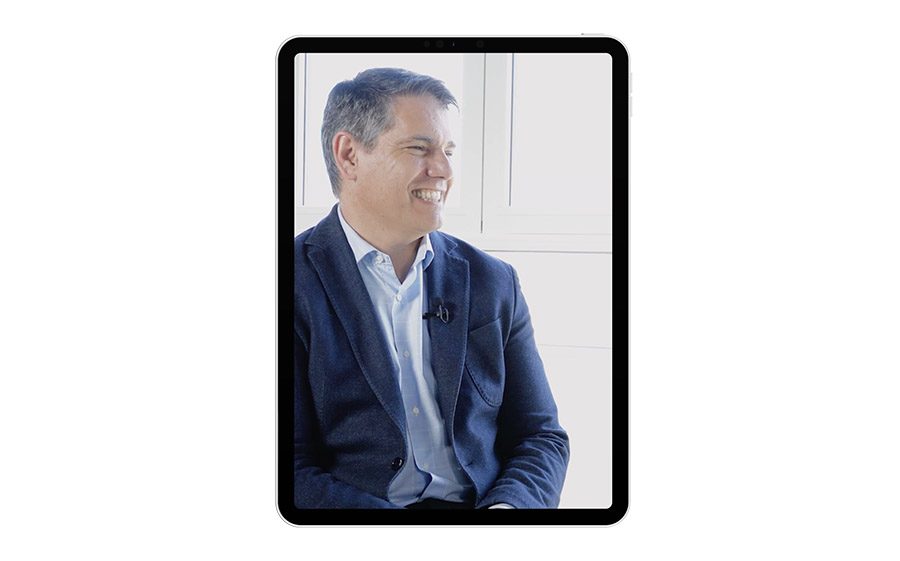
Toni Seijo is an expert researcher in Customer Experience and a board member of the IE Center for C-Centricity. In this interview we wanted to ask him how sales have been transformed in recent years and what role people should play in selling in a reality increasingly marked by new technologies.
Today we speak with Toni Seijo, an expert in Customer Journey. Toni, we could say that you dedicate yourself to guiding companies in terms of their Marketing strategy. Would you like to go into a little more depth?
Toni Seijo: That's right. I would highlight that I do this based on information: about customers, about consumers in general, etc. This in my professional capacity.
And then there would be the academic side?
Exactly. I collaborate with different business schools and I am a member of the board of the Customer Centricity Center of the Instituto de Empresa, where we carry out academic research on Customer Experience.
As an expert in what refers to the customer, this “customer”, what would you say is the role of salespeople today? Taking into account that in-person interactions are increasingly reduced.
The salesperson who sells in person must be understood in the context of the Customer Journey, which is the journey the customer makes from the moment a need is triggered until they manage to fulfil it. Within this journey there are two major stages: an exploration stage in which the customer is gathering information and discovering the brand, and a later “closing” phase. At this point the customer is evaluating their options and the sales activity comes into play.
Is the salesperson the one who helps them decide?
Something like that. Once the customer is evaluating, they can contact the company through different channels, and there an expert person will explain what they need to help them close this process by choosing the best option.
That is, like a companion who makes the purchase process better.
From this point of view, the role of salespeople in one-to-one dealings remains fundamental. But of course times have changed and it is no longer enough to go with your briefcase, your brochures...
Now there are new technologies.
That is where the role of the salesperson is revolutionised and enhanced. But it is not lost.
Recently, Andy Stalman, in a conference in Barcelona said that “everything is branding”, of course also the sales visit. How do you do “good branding”?
This reflection is really very current. branding has changed. It is no longer the big advertising campaigns. Now the brand is an integral concept of the company. If a company wants to compete and stand out it has to work on its brand, its reputation and how it presents itself to the world in general.
And how should a company present itself?
To summarise very briefly, it is about offering what the company's brand promise is. What can the company do for its customers? The customer is attracted by the promise and then, when they interact with the company, the experience is co-created. And there must be consistency between both things, that is key.
And salespeople intervene in how this experience is.
Yes. In this the role of the salesperson is key. They must understand and speak with a sales narrative that is consistent with what the brand has already been telling the potential customer at the different points of the Customer Journey.
Of course, but also nowadays customers can come into contact with the brand through many different channels. What resources can help us so that the customer has that feeling of consistency?
Firstly, it is not at all easy. The management of omnichannel has many difficulties and the channels do not stop growing. In English there is a word that sums up very well the path to follow: seamless experience.
¿Seamless as they say in some items of clothing?
Exactly, it means without seams. That is, the idea is that, regardless of how the customer enquires, communicates or buys, the brand experience has to be the same. Whether entering the website or presenting themselves at the offices, it has to be a consistent, unified experience. That is fundamental.
Also in the salespeople's discourse.
In all cases there must be a way of expressing oneself, a code and a brand purpose absolutely defined and standardised. And within this, in personal contact, which is usually the most memorable contact of the Customer Journey, is where the whole plethora of touchpoints has to be synthesised. And who provides this memorable contact?
The salesperson.
The salesperson. In the sales discourse the salesperson is the one whose function is to present a message consistent with everything the potential customer has seen and already knows about the brand.
And new technologies, how can they help us in this?
I would mention three major areas. Firstly, in audiovisual. Technology allows salespeople to explain with much clearer demonstrations in a multimedia environment. Then another area would be personalisation. What is the right content for the moment of the Customer Journey in which the customer finds themselves? Anticipating the customer's needs and questions makes the interaction much more agile and the customer makes the decision sooner.
And a third area would be missing.
The last part where technology has a fundamental impact is in everything that is Data Analytics. The more relevant information the salesperson has at their disposal, the better they will be able to conduct the visit. These three elements are revolutionising sales activity.
Is control of information the key to engagement nowadays?
Look, let me present an example. As a company it can happen that you have customers you have been working with for a long time, you offer them the best price, the best conditions, the best product, the best assistance... But a moment comes when they tell you: hey, I'm going with the competition. Why? Because this doesn't exist engagement.
And what has failed there?
That engagement is not functional, it is emotional. You have to create an emotional proximity with the customer. Emotions play a very important role in loyalty. And the ones who deliver emotions best are people. That is why salespeople have a fundamental role.
What kind of things favour this emotional proximity?
It is generated in many ways. For example, getting them out of a tight spot, anticipating their needs, congratulating them on their birthday, among many others. Boosting engagement does not have to be an invitation to dinner, which it can also be, but the important thing is to understand what moves that customer. Are they a person who seeks to do things well? Someone who feels in control? What is the person like? And what are they looking for? Understanding the person is the key to engagement.
With all this, how would you summarise what the future of sales is? Both at a technology level and at a human level.
In the world of Business to Business, the evolution is clearly towards the replacement of the person's expert knowledge by the brand's expert knowledge. For example, all the algorithms of Machine Learning and Data Analytics that we were commenting on earlier, to anticipate what the client is going to do. A machine can do this very well. However, what is the role of the person? Will the salesperson disappear? No. The salesperson has this point of empathy with the other person that is essential.
This part technology cannot cover.
No, not at the moment. The salesperson understands what concerns the client and how they want to be helped. Therefore, what has happened is that salespeople no longer need to be experts in a subject and know every detail; technology is already there for that. They must understand the business, of course, but the most important thing is to understand how that business can help the potential client. This is something that machines cannot do.