













Virtual meetings have become an essential part of the future of B2B sales, and we want to help you nail them.
For some time now, and especially since the 2020 pandemic, video conferencing has become the new normal for businesses. In 2024, it seems that meetings beyond the physical world remain the norm for many B2B business interactions, due to the ease it offers in avoiding certain travel and resolving certain issues quickly.
Although there are many differences between in-person and virtual meetings, an online sales meeting has the same capacity to attract potential customers, nurture opportunities or drive deals and even keep relationships with regular customers active. It can also sometimes open the door to new customers beyond our geographical boundaries.
That is why it is important to know the best practices when it comes to successfully organising a sales meeting. Today we bring you 6 tips that you can easily pass on to your sales representatives and that will help them thrive in the virtual environment as much as they do in their in-person meetings.
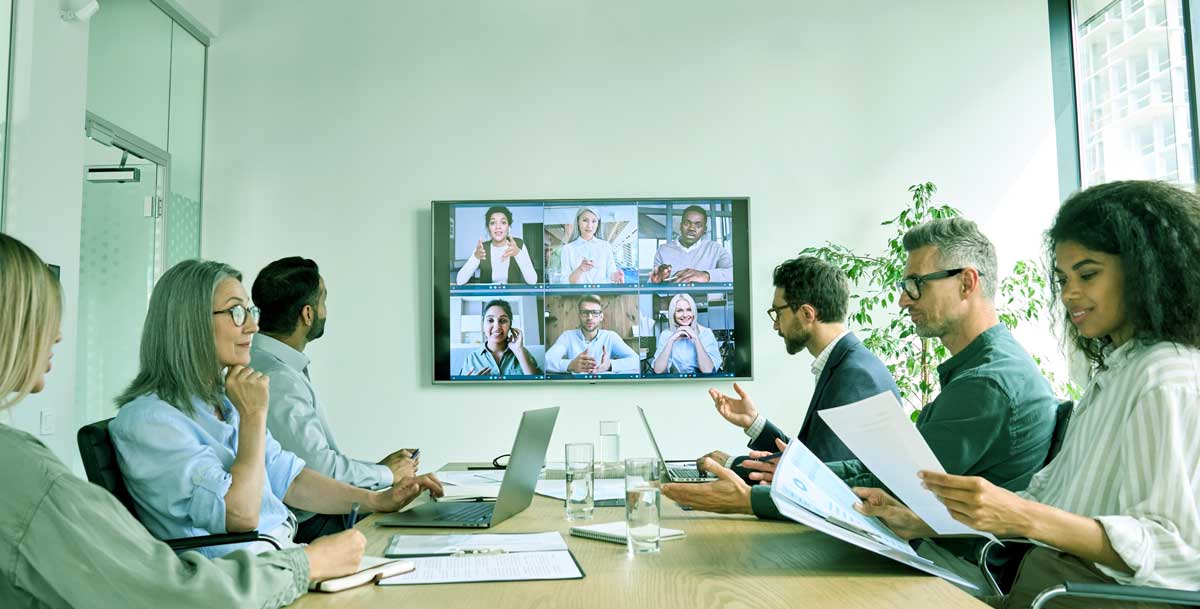
These are some of the basic best practices that representatives should internalise to hold successful virtual meetings.
7 tips to nail your virtual meetings
1. Prepare for the meeting with personalised content
Any sales meeting involves a certain amount of preparation. Whether it is presenting our product for the first time or a review with a regular customer, meetings are moments that mark a before and after in sales success. This should not be different just because the meeting is held virtually or even from our own home.
As in an in-person meeting, virtual ones must be participatory on the part of all attendees. Sometimes customers have lower expectations and assume it will be a one-sided presentation. But it should not be like that. It is important to convey to the customer that the meeting will be approached like an in-person get-together.
To do this, preparation before the sales visit is key: research the market, offer performance analyses, prepare up-to-date information and, very importantly, personalise the content for each meeting. This will make the customer feel taken into account in the meeting and encourage them to participate, with questions more focused on their needs.
For example, a salesperson well prepared for the meeting would send relevant content to the customer before the video conference, and a brief summary of the key points at the end.
2. Know the technology you use well and teach it
Sales representatives should know the best video conferencing solutions inside out. Most likely, in a business context a single platform is usually used, but salespeople should be familiar with the different options that are most popular, so they can adapt to the customer's preferences, which is why the company should provide this training.
In this regard, it is a good idea to practise with the platform well before the meeting takes place, especially if the representative has never used the system before. Time should be spent navigating the interface and testing its various controls: muting, screen sharing, chat, recording, etc.
This way, we can avoid wasting time on technical issues, so that the salesperson can focus entirely on the conversation with the customer during the meeting.
But that is not all. If you organise the meeting on a platform that the customer is not familiar with, it is very useful to send them some instructions along with the meeting invitation, with basic tips on how to install, open and use the tool. You can also spend some time at the start of the meeting going over the basic pillars of the platform and how they will be used in that conference.
3. Capture attention by sharing content
It can be difficult to capture the attention of attendees at a meeting without the help of a striking visual or interactive element. In fact, visual resources are also essential for participants to better retain the points discussed in their memory.
The sales team is likely to have a large amount of sales content that they usually use in in-person visits. It is advisable that this content has its digital version, as the screen-sharing option is a great way to actively involve customers; also using content that we already know can resonate with them.
Some video conferencing tools also have whiteboard functions, which are a good resource for involving participants with a more interactive presentation where we can add information in real time. It can help us better present products, analyse options or brainstorm that adapts to the customer's needs.
4. Have a plan in case of technical issues
That said, even the most carefully prepared plans for a virtual sales meeting can be affected by technical issues, such as Internet outages or other problems.
If virtual meetings are a regular thing, sooner or later it will happen, so it is better to have a plan to solve them or have alternatives. Preparing these options can help representatives keep the meeting under control in any circumstance, which also allows them to be more relaxed.
For example, we can consider situations such as a customer being unable to connect. We could try again at another time, from another profile or finally connect by phone to at least get in touch.
Although these things seem unimportant, any problem, even if it is not the representative's fault, can affect the sale. Having a plan to save the situation, even if we only have to use it for a few minutes, can make the difference compared to our competition.
5. Convey professionalism
Professionalism is the ideal of sales meetings, and the way you present yourself virtually should be as polished as if you were meeting in person. This includes both clothing and the place where you decide to focus your camera.
For example, you should dress as appropriately as if you were in an in-person meeting, and sit in front of a desk or something that conveys that this is a workplace. Other details would be the camera angle, front lighting or, if the situation requires it, virtually applying a background that is representative of the company.
Depending on the context and the type of customer, changing the background can serve to give the meeting a fun and relaxed touch, although you should still maintain the same professional treatment you would have with the customer in person.

6. Listen and moderate interactions
When it comes to a sales meeting, representatives should be the ones leading the meeting, so they will have to be the ones enforcing the etiquette rules of any meeting, including if it is virtual.
In this, there are certain tricks that can help us. For example, participants who are not speaking should be muted to avoid too much background noise and attendees not being able to hear an intervention properly.
Of course, to lead by example, representatives should also avoid distractions, such as email, phones and things in their environment, and show themselves attentive during others' interventions.
In a virtual meeting, it is easier for the person speaking to feel that they have lost the attention of others, so it will be key for the client to feel heard, and we must ensure that our contributions demonstrate that this is the case. It is also a good idea to dedicate time to clarifying doubts and doing what is necessary to ensure that everyone has understood the essential points of the meeting.
7. Apply the same follow-up as in other meetings
Remember to end each meeting with a summary of the points that can be put into practice. This helps to reinforce clarity and communication, which are essential in virtual environments. In any case, try to over-communicate the follow-up points so as not to leave room for misunderstandings or errors.
At a minimum, this involves sending a summary by email with a list of the next steps. It also means recording the information in a CRM or a sales enablement platform so that the conversation can be recorded and used in analysis.
In conclusion
In summary, if we have to define a successful virtual meeting, it would be: as similar to an in-person meeting as possible.
Of course, sales representatives have a great responsibility as those in charge of ensuring that this is fulfilled, but they should not be alone.
General and sales management must ensure that the sales team has sufficient training and tools to carry it out. In other words, sales empowerment is key in this new context of B2B sales.
If you want to know more about the best techniques and tools for training your salespeople and ensuring that sales empowerment is achieved, we encourage you to visit other articles on our blog y our series of Video-Tips to sell more and better.