













[We continue this series of three articles in which we explain what makes Caitium so special and interesting for B2B companies]
Role logic: each user sees and uses AI according to their context
One of the particularly important aspects in a B2B environment is that NOT all users should be able to consult the same information. A sales director, a salesperson, a marketing manager or a professional client have different needs and permissions.
Caitium incorporates a role and permission logic that makes it possible to adapt responses and access to information according to the user. For example, a salesperson can consult information related to their client portfolio, while management can work on an aggregated view of the business. This allows the AI to respect the company's commercial structure and be consistent with its information access policies.
Therefore, the question is no longer just: “What does the AI know?” but: “What should each user be able to know and do?”

All commercial information in a single ecosystem
The incorporation of artificial intelligence in companies does not depend solely on technology. One of the main challenges to achieving reliable results is having well-organised commercial information, up to date and accessible.
In many organisations, knowledge is scattered across different systems and departments: product sheets are stored in one system, price lists in another, while technical documentation is in PDFs, sales presentations in shared folders and other relevant data remains within the ERP or in the knowledge of the teams themselves.
This dispersion makes it difficult for artificial intelligence to interpret a company's commercial context and use the information coherently.
To solve this problem, Caitium incorporates a layer of Content Hub / PIM that makes it possible to centralise and structure the commercial knowledge that the AI subsequently uses. The system can integrate everything from product descriptions and technical characteristics to documentation, images, sales pitches, internal notes, multilingual content, logistics information or catalogues.
In this way, the AI stops working on isolated documents and disconnected sources and instead has a structured commercial context, which allows it to better understand the catalogue, the products and the needs of the business.
The organisation of information thus becomes a key element for the AI to be able to move from being a generic tool to becoming a technology truly integrated into the company's commercial processes.
Connection with the ERP and the real data of the business
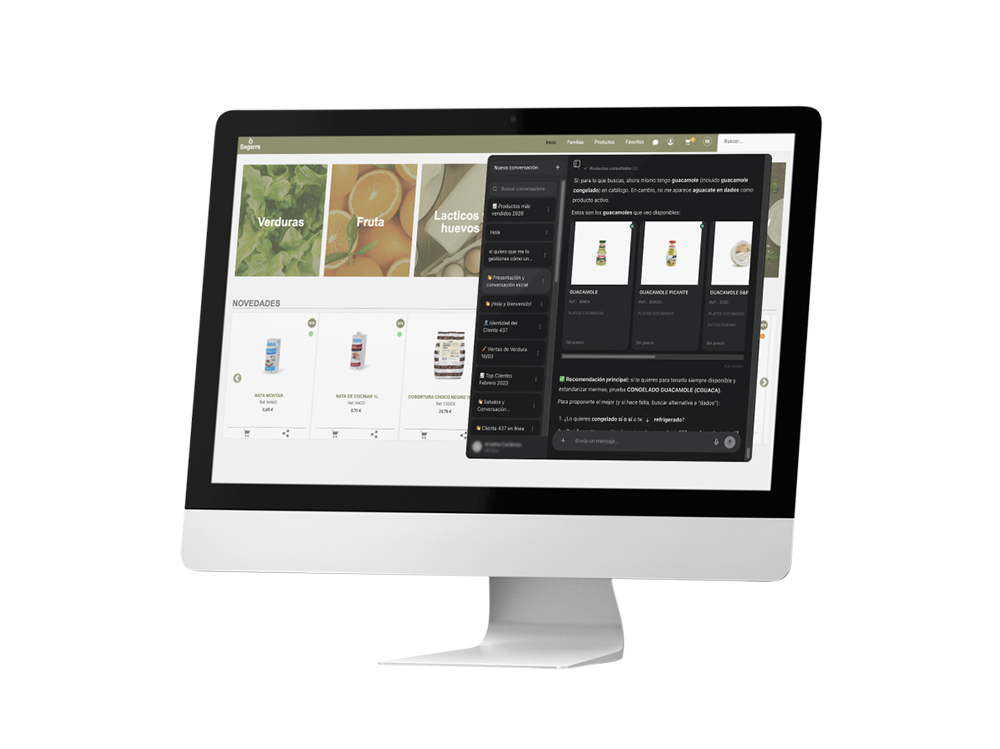
The value of an enterprise AI agent increases enormously when it can combine documentary knowledge with operational data. Caitium can be integrated with the company's management systems to work on information from the ERP or other corporate systems.
This makes it possible to combine two basic dimensions, commercial knowledge and business data. This combination is especially powerful because it allows the AI's responses to be linked to the real context of the client and the company.
| Commercial knowledge | Business data |
| What is this product? What characteristics does it have? What type of client is it indicated for? What documentation exists? |
What stock do we have? What price does this client have? What have they purchased previously? What promotions do they have available? What orders have they placed? |

From conversation to the B2B order
One of the points where the difference between an informative assistant and a commercial assistant is best visualised is that with Caitium, the conversation can become the entry point of a commercial operation.
Let's take a practical example:
Can you imagine being able to tell your Agent: “I need to prepare an order for the client with 10 units of product A, 20 of product B and add the available promotion.”
Caitium can help interpret the request, identify the products and drive the process through to order generation according to the defined rules. This opens the door to a new concept: conversational B2B commerce. The user no longer necessarily needs to navigate through screens, filters, menus or catalogues to reach the result.
They can express their need directly using natural language. And this model can be applied both to sales teams and, in certain scenarios, to B2B clients themselves.
What do you think?
[To be continued]
Continuation
What sets Caitium apart from other AI agents? (3): An intelligence layer integrated with knowledge