











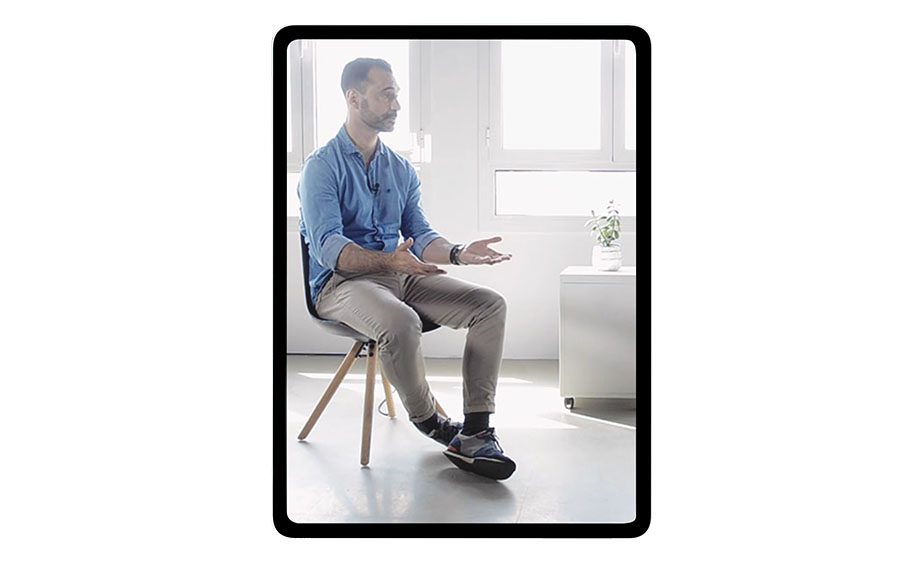
Javier Corral he is a digital advisor focused on branding and digital marketing issues and a master's lecturer in the field of marketing and digital sales. In this interview we asked him how new technologies –or sales tech– have transformed the way sales teams work and how they can facilitate everything from the onboarding process to closing the sale.
— First of all, Javier, could you tell us a little about what being a digital advisor involves?
Javier Corral: Mainly I advise on digital marketing, branding, and I also teach on a couple of master's degrees, precisely in these specialities, both marketing and digital sales.
— Thinking about advising in the field of sales, what challenges does a salesperson face?
The first problem a salesperson can encounter is not having a planned landing in the company. When a salesperson starts at a company, it is very important to have an onboarding process.
— How can we carry out a successful onboarding?
Look, there is a common question, which is: what should this onboarding be like? The answer is very simple: it must exist. It must be prepared, it must be structured and, above all, it must avoid some common mistakes.
— What mistakes are we talking about?
That it is a cumbersome process, that it is an accumulation of information, that it is too long, that this training is not guided, that it drags on excessively… Luckily, we have tools to solve this, such as technology.
— What technological solutions are we talking about?
Technology allows us to make the process much more visual and, above all, with content that is up to date. It can be kept permanently up to date and well structured. The key to technology is that it provides the sales team with tools they will subsequently have to work with.
— That is, it facilitates the onboarding process but also the salesperson's work in general.
Yes, although we must not forget that this technological part is very good as a complement. We must not overuse it excessively. For example, something I always say is that onboarding must be structured and automated as far as possible. But then if we can personalise it with something as simple as: a welcome kit, company merchandising, a personalised letter, great. We must not forget this part. Automation does not cover everything.
— And if we had to summarise what technology does do for the company?
That's it, making the process simple. Taking advantage of all the tools and ensuring the salesperson has access to all the content, to learning from other salespeople… and above all, that it is up to date. This is what can be automated.
— Speaking of automation, nowadays the possibilities of Artificial Intelligence for sales are much discussed. How can AI help us with this?
It has a huge number of applications! A salesperson has to do many things, but I think we will agree that in the end their goal is to sell, to get more customers and to achieve more sales. So, if a salesperson's main goal is to sell, let's eliminate all those routines, procedures and processes that could be done through automatic procedures. That is the first benefit of artificial intelligence.
— Freeing them from certain routine functions. And a second benefit?
The next thing is to provide the salesperson with up-to-date content. That is fundamental, because with that they will be able to provide value content to the customer. And adding to this a huge number of tools that optimise the work. In addition, AI can make product recommendations tailored to the customer, offer upselling and cross-selling options… basically it allows sales to be personalised based on all the information we have accumulated about that customer and other customers.
— So, beyond the onboarding process, how can Sales Tech technologies help us in sales?
We must take advantage of Sales Tech to facilitate, boost and increase sales. Something we always talk about is digital transformation in the world of sales… And although we are talking about digital tools, digital transformation is about people. In the end they are nothing more than tools that facilitate or boost our day-to-day work. People must be behind all these technologies.
— And how can the company boost this?
The company's philosophy must favour and encourage the use of these technologies. The first thing that must be digitally transformed is the company's culture. I insist, this is about people. For example, a well-used CRM is a sensational tool. But a CRM should not be, as happens in some cases, a control tool. What we must achieve through Sales Tech is much more.
— Much more than having control?
Yes, it is a much broader world. Tools are not just for recording. They can facilitate, suggest, help, eliminate unnecessary tasks, propose new products, update information, give recommendations for the future…
— Returning to the CRM example, let's say what differences are there between a traditional CRM and the possibilities that Sales Tech opens up for us?
Traditionally the CRM has required interpretation by the person who was using it. Or, in fact, it was the same person who extracted the information they considered important. What Artificial Intelligence allows us now is for the salesperson to receive recommendations, suggestions, forecasts… What is the best time to make a visit? What are the best products? or even When should I come back? What should I propose to the person?
— It is also true that technology gives the customer the ability to carry out on their own processes that previously fell to sales teams? We see this clearly with e-commerce. How does this autonomy come into play?
A while ago, in a talk given by a Telefónica executive, he gave the example of Amazon. Amazon already knows in advance what you are going to buy and has it prepared in the warehouse, even before you buy it. So, where does this autonomy reach?
— One thing in exchange for another? More autonomy, but the company has more information to guide this autonomy?
Customers remain autonomous. But it is true that data makes the sales process more agile. Artificial intelligence can predict a customer's behaviour. Then there is always the human component, which is not entirely predictable, but of course, if we talk about data at a macro level, we can establish trends or purchase recurrence, intuit, with a high degree of reliability, where a customer is going to go or what they will end up buying in the future.
— To finish, how would you say sales will be in the future? What is the key concept?
I wish I had the perfect answer. I believe the key lies in access to information. Access to information is now open to everyone, not only to the seller, but also to the buyer. Sales no longer consist so much of the salesperson setting out the features of a product. I believe sustainable selling in the future will be more consultative. The seller not only as a person who has information, but as a person who advises, accompanies, facilitates, manages the sales process. On a much more equal footing. We people like to think that we don't buy, but that we choose. And the seller is the one who must guide us.
You can watch the full video interview: