















The 5th study of the Digital Maturity Index in Spain has given Spanish companies a grade that could be improved: a bare pass.
The aim of the study was to measure the degree of digital maturity of companies in Spain, as well as the evolution of their stages over time, based on the fourteen key indicators of digital transformation.
According to this study, carried out by the team of analysts at INCIPY in collaboration with Indeed, Spanish companies continue to drive the definition and implementation of digital transformation strategies in the wake of the pandemic. However, the data do not show great growth compared with the previous year.
In total, Spanish companies have been rated at 5.3/10 for digital maturity
5.3 out of 10, why?
The study was carried out by interviewing 330 executives from companies of different sizes and sectors and has provided interesting data that can help us understand how Spain could improve its score.
For the study, 14 key indicators of digital transformation, were established, including parameters of digital strategy, customer centricity, digital business and also people and culture. This includes the digital roadmap, customer experience and omnichannel or the recruitment of digital talent, among others.

Of the 14 indicators, the one that has received the highest rating from Spanish companies has been transformative leadership, with 85% of companies stating that they support digital transformation from senior management.
However, the score remains at a bare pass due to a certain mismatch between the intention to transform and the definition of specific strategies. Thus, while 73% of companies state that they have a digital roadmap, 27% (81% more than last year) state that they do not have it fully defined.
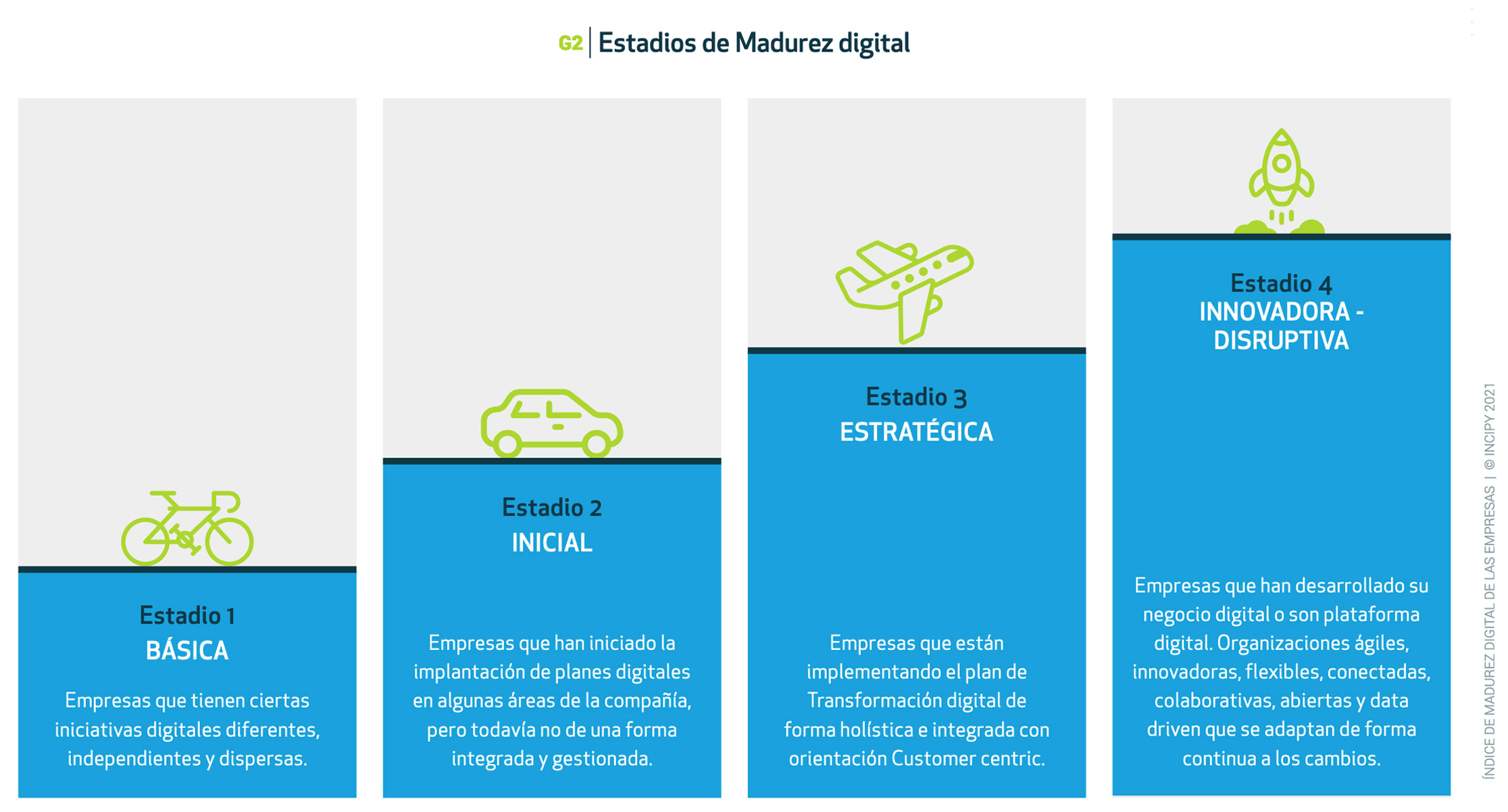
Based on these 14 indicators, companies have been classified into 4 stages of digital maturity: basic, initial, strategic and disruptive. In Spain, the data indicate that 31% are Strategic and 11% Innovative-Disruptive.
With all this, we see digital progress that remains constant, this being the second consecutive year that Spain has passed, but it still has a long way to go.
A higher score in a few years' time?
According to Byte, magazine, the digital growth that Spain still has to achieve could be explained by the delay in the arrival of Next Generation EU funds.
One of the key questions of the study was whether there was any intention to apply for European funds to finance the company's digital transformation. 28% of companies indicated that they would apply for Next Generation EU funds and a further 47% are considering applying for them. 28% of companies stated that they would apply for Next Generation EU funds and a further 47% are considering applying for them. This is a recovery programme endowed with €750 billion in total, which aims to boost the economic growth of the member states.
This funding could be an important digital accelerator in 2022, so we can expect this 5.3 to increase in the coming years.